The Tesla Powerwall dolly, explained
A Powerwall 3 weighs 130 kg and has to end up on a wall bracket. Tesla's answer is a purpose-built dolly — Tesla P/N 1856187 — rated to 136 kg, with a drill-driven lifting screw. Here is what it actually is, what Tesla's manuals do and do not require, and how the cost of owning one compares to hiring it for the jobs that need it.
A lifting trolley built for one job
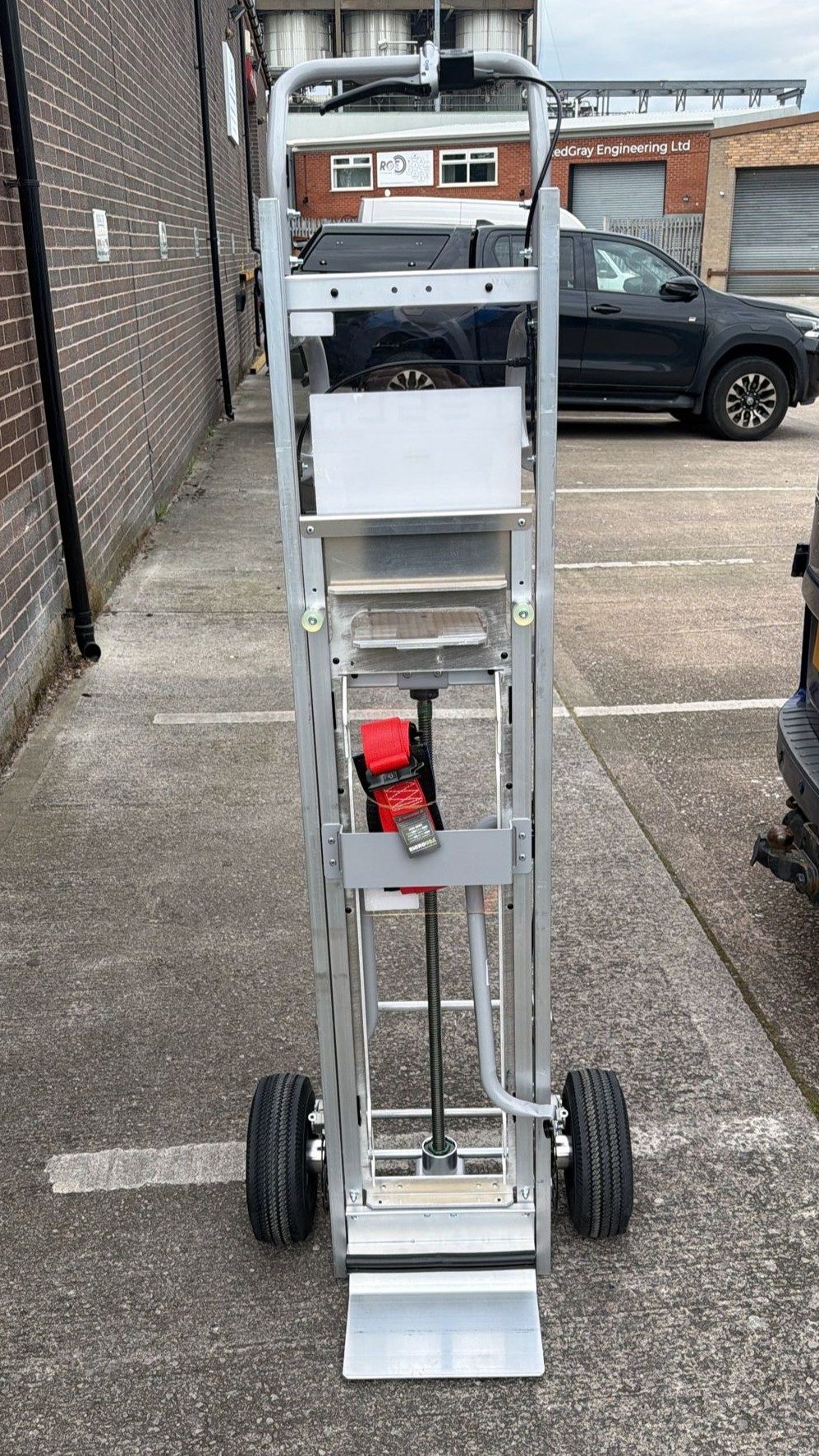
The Powerwall dolly is not a general-purpose sack truck with a Tesla sticker on it. It is a wheeled lifting frame with a vertical lead screw running up the mast. You fit a 19 mm socket to a cordless drill, strap the drill to the screw head, and drive the screw to raise or lower the Powerwall in a controlled, repeatable way — no straps taking the load, no lifting from the knees, no second person holding the weight while the first lines up the bracket.
Underneath it runs on pneumatic tyres with a single lever actuating dual hydraulic disc brakes. That combination is the reason it matters on real sites: a 130 kg unit on solid castors is unmanageable on a gravel drive or a set of front steps, and a trolley without proper braking is genuinely dangerous the moment the ground slopes.
The dolly itself weighs 24 kg and is compatible with every Powerwall generation — Powerwall 2, Powerwall+ and Powerwall 3 — though it attaches to each differently. Tesla lists it under part number 1856187-xx-y.
Tesla's published figures
Taken from Tesla's Powerwall Dolly specifications in the Energy Library. Metric conversions are Tesla's own.
Worth noting, because it catches people out: the 686 mm maximum lift height is to the base of the Powerwall. Tesla notes it can be extended to roughly 39 inches using a platform. If your bracket is set high on a garage wall, check the height before the unit arrives — this is a limitation of the tool, not of any particular supplier.
Does Tesla require the dolly?
No. Tesla's Powerwall 3 installation manual is unusually clear about this. In the required tools list, under lifting equipment, it reads:
"Powerwall dolly (preferred, Tesla P/N 1856187-xx-y) OR lift equipment capable of lifting and supporting 287 lb (130 kg)"
TESLA POWERWALL 3 INSTALLATION MANUAL — REQUIRED TOOLS
Two things follow from that single line. First, the dolly is preferred, not mandated — you are not out of compliance for using something else, and your warranty position does not change. Second, whatever you use has to be rated for the full 130 kg. That rules out most of what is already in the van.
If you go the alternative route, the same manual adds a ratcheting strap to the tool list to secure the unit to whatever lift you are using. So the honest summary is: the dolly is a speed and safety upgrade, not a legal requirement — but "make do" needs to mean properly rated equipment, not improvisation.
Powerwall 2 and Powerwall 3 attach differently
The same dolly does both, but the procedure and the socket are not identical — which matters if you have only ever done one generation.
Lift handles and a locking plate
Lift handles attach to the unit — the larger rounded handle at the top, the smaller angled one at the bottom. A lifting plate slides underneath while the Powerwall is still in its packaging, then a locking plate engages to capture the handles. Tesla's procedure explicitly says to stand the unit upright with a partner before engaging the brake and unpacking.
Needs a ¾ inch socket, and a T40 driver on dolly versions with part numbers 1856187-xx-G or later.
Ratchet strap, run twice
No handles or locking plate. The unit is secured to the dolly with a ratchet strap fitted with a protector sleeve. Tesla is specific that the strap must be run through the slots twice, so the Powerwall cannot shift side to side in transit.
Needs a 19 mm socket. Same drill settings: low gear, clutch one level below maximum.
Both generations use the same drill setup — a standard 18–20V cordless in low gear with the clutch one step below max, strapped to the lifting screw. Tesla is explicit that impact drivers must not be used.
Buying versus hiring, with the actual arithmetic
A new dolly through the UK trade channel runs roughly £2,500 to £2,833. Hiring one from us is £90 a day or £250 a week — all rates ex VAT — plus delivery banded by distance from Manchester, or free if you collect.
The break-even depends almost entirely on whether you collect or we deliver, so here is both, honestly:
Cost per job is the £90 day rate plus the round-trip delivery band for that distance — £85 at 15–30 miles, £190 at 50–80 miles. A £49 minimum delivery charge applies. All figures ex VAT; full bands on the pricing page.
We would rather say this plainly than lose your trust over it: if you are fitting two or more Powerwalls a month, every month, and you are not local to us, you should buy one. The maths stops favouring hire somewhere around five to seven months of steady volume, and owning removes the scheduling dependency entirely.
Hiring earns its place in three situations. When Powerwall work is occasional — a handful of installs a year alongside other electrical work, which describes most of the subcontractors doing the physical lifting. When you are covering overflow and your own dolly is on another van. And when you are starting out: £2,500 of capital in a tool is a different decision when you have not yet proved the workflow.
Getting hold of one in the UK
To buy, the dolly is stocked through UK and European solar trade distributors — Segen and CCL among them. Availability has been intermittent: there are ongoing installer discussions about Powerwall 3 dolly supply, and lead times move around.
To hire, that is us. We hold the dolly in Manchester and deliver anywhere in England, Scotland and Wales, priced by distance band, with self-collection free if you are passing. Send a postcode and your install dates and you will get availability and a delivery price back the same day.
Straight answers
How much does a Tesla Powerwall dolly cost to buy in the UK?
Roughly £2,500 to £2,833 through the trade channel, depending on distributor and stock. Hiring is £90 a day or £250 a week plus delivery, all ex VAT, which works out cheaper than owning until you are doing somewhere around nine to fifteen installs, depending on how far you are from Manchester.
What weight is the Powerwall dolly rated to?
300 lb, or 136 kg. A Powerwall 3 weighs 130 kg, so the dolly carries it with a small margin. The dolly itself weighs 24 kg.
Do I have to use the Tesla dolly to install a Powerwall?
No. Tesla's Powerwall 3 installation manual lists the dolly as preferred, but permits any lift equipment capable of lifting and supporting 287 lb (130 kg), secured with a ratcheting strap. The dolly is a speed and safety upgrade, not a compliance requirement.
What tools do I need to operate it?
A standard 18–20V cordless drill in low gear with the clutch one level below maximum, plus a 19 mm (¾ inch) socket. Impact drivers must not be used. Powerwall 3 work on newer dolly versions (P/N 1856187-xx-G or later) also needs a T40 driver, and the drill strap comes with the dolly.
Can one person do the lift with a dolly?
The lift itself, yes — that is the point of the drill-driven screw. But Tesla's Powerwall 3 procedure calls for a partner when standing the unit upright before unpacking. If you are working alone, our delivery + man option puts a second pair of hands on site for £35 on top of delivery.
How high can the dolly lift?
686 mm to the base of the Powerwall as standard, extendable to around 39 inches with a platform. Check your bracket height before the job if the unit is going high on a wall.
Does it work on stairs and rough ground?
Yes — pneumatic tyres and dual hydraulic disc brakes on a single lever are exactly what make it usable on gravel, thresholds and steps. This is where it separates most clearly from generic lifting gear.
Got a Powerwall going in this month?
Tell us the postcode and the dates. We will come back with availability and a delivery price.